Premap & Relocalization
Relocalization lets a Go2 navigate on a previously built map instead of only on what it sees right now. At runtime, RelocalizationModule aligns live LiDAR to a saved premap and publishes a world → map transform, so the costmap and planner operate on the live scan and premap together.
Note: Requires dimOS v0.0.13 or newer for PGO loop closure and
dimos mapexport.
This guide takes four steps:
- Record a walk-through with
unitree-go2-memory - Build the premap with
dimos map global {DB_NAME} --export - Test relocalization in replay, no robot needed
- Deploy on the live Go2
Throughout this guide, {DB_NAME} is the stem of your recording, for example recording_go2 for recording_go2.db. For map_file, pass the same stem and dimOS appends .pc2.lcm automatically.
1. Record a run
Drive the Go2 through the space you want as your premap. Close loops when you can because PGO uses revisits to correct drift.
If ROBOT_IP is set in the environment or .env, you can omit --robot-ip:
This writes recording_go2.db to the repo root (DIMOS_PROJECT_ROOT) and records lidar, odom, and color_image plus the live TF tree. dimos --record run unitree-go2 records the same streams (and every other one) to recordings/<run-id>/memory.db instead; see Recording. The recorder stamps lidar frames with the latest odom pose so dimos map global can reconstruct poses later- see Go2Memory.
Quick validation (optional)
Before building a premap, inspect the recording:
summary prints stream names and time ranges. replay opens Rerun so you can confirm lidar and odometry look sane.
2. Build the premap
Export a loop-closed global map as .pc2.lcm:
| Flag | Effect |
|---|---|
--export | Run PGO and write ./{DB_NAME}.pc2.lcm to the current working directory (implies --pgo) |
--no-gui | Skip launching Rerun for headless servers or CI |
--pgo-tol 0.3 | Spatial dedup tolerance for keyframes in meters. Use 0 to keep all posed frames |
--voxel 0.05 | Voxel size in meters (default matches live mapper) |
{DB_NAME} accepts a bare stem, ./path/to/file.db, or an absolute path. Bare names resolve in this order:
- Current working directory
DIMOS_PROJECT_ROOTdata/via LFS (get_data)
Examples:
dimos map global recording_go2 --export --no-gui
dimos map global ./recordings/office_walk.db --export
dimos map global data/go2_hongkong_office.db --export
Sample log:
running PGO twopass map...
  Pass 1: 908 frames, 1 keyframes
exporting PGO twopass map to .../recording_go2.pc2.lcm...
wrote .../recording_go2.pc2.lcm
Open the companion {DB_NAME}.rrd in Rerun to verify loop closure before deploying to hardware.
3. Relocalize in replay
Test alignment without the robot. unitree-go2-relocalization is unitree-go2 plus RelocalizationModule:
map_file resolves {DB_NAME}.pc2.lcm with the same search order as above (cwd, then project root, then data/).
Reading the logs
Relocalization module started: map_file='recording_go2'  loaded_map.frame_id='map'
relocalize skipped: n_pts=37770 < MIN_LOCAL_POINTS=50000
relocalize rejected: fitness=0.433 < threshold=0.45 time_cost=8.1s n_pts=57385
relocalize: fitness=0.657 time_cost=3.0s n_pts=64703 reloc_t=[-0.007, -0.01, -0.102] TF 'world' -> 'map' published_t=[0.007, 0.009, 0.102]
relocalize skipped means the live submap is still warming up- fewer than MIN_LOCAL_POINTS points accumulated. relocalize rejected means a candidate alignment was found but its fitness was below the threshold, so no transform is published. Once relocalize: lines appear at info level, the world → map TF is live.
You can replay a different .db from the same physical space against the same premap to test generalization.
Rerun visualization
Watch alignment in Rerun, which is enabled by default on Go2 blueprints:
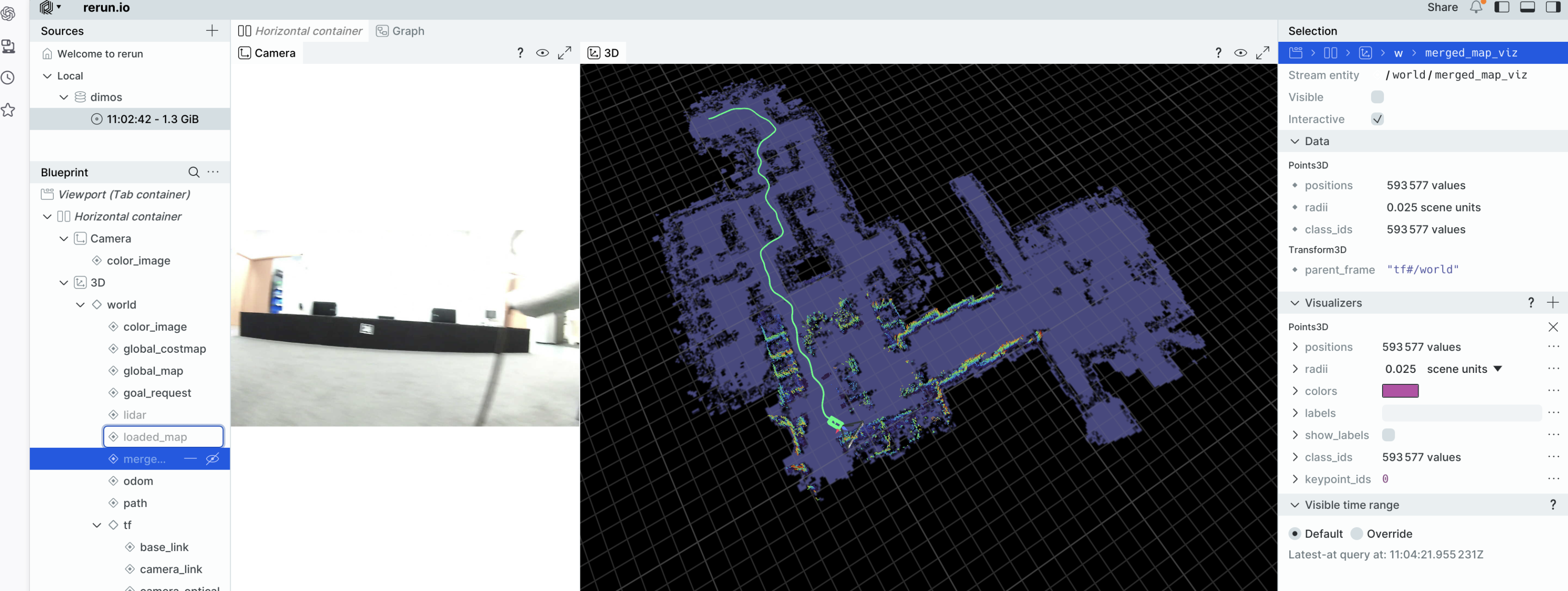
- Merged map shows the premap transformed into
worldplus the live scan, column-carved together. - Toggle the merged map entity off to compare the live scan alone against the merged costmap.
4. Relocalize on a live robot
Run the replay test first. On hardware, use the same blueprint and map_file:
Before sending navigation goals, walk through this checklist:
- Place the Go2 in a region that overlaps the premap on the same floor with recognizable geometry.
- Wait for
relocalize:info lines. Skipped and rejected lines are normal for the first 30 to 60 seconds. - Confirm stable
world → mapTF in Rerun before sending navigation goals. - Click to navigate or use agent skills such as
navigate_with_texton the aligned costmap.
How it works
The unitree-go2-relocalization blueprint is the standard Go2 navigation stack plus RelocalizationModule:
diagram source
from dimos.core.coordination.blueprints import autoconnect
from dimos.core.introspection.svg import to_svg
from dimos.mapping.relocalization.module import RelocalizationModule
from dimos.robot.unitree.go2.blueprints.smart.unitree_go2 import unitree_go2

unitree_go2_relocalization = autoconnect(
    unitree_go2,
    RelocalizationModule.blueprint(),
).global_config(n_workers=11)

to_svg(unitree_go2_relocalization, "assets/go2_reloc_blueprint.svg")
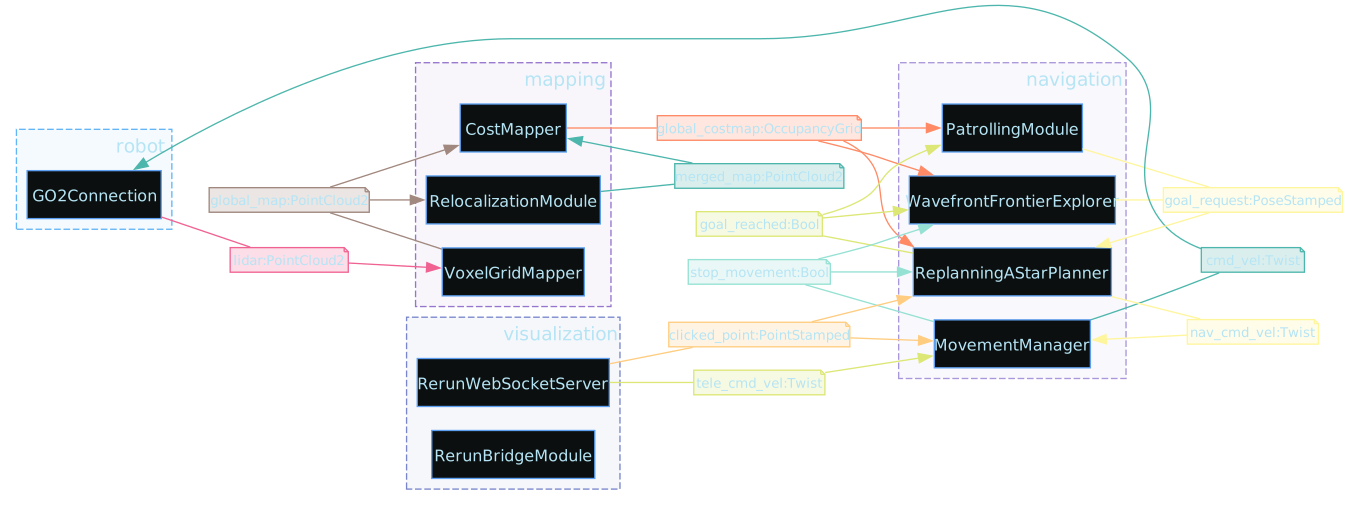
Note that CostMapper builds the costmap from the merged map only while RelocalizationModule has a good alignment; until then it falls back to the live map alone.
File formats
| File | Format | Produced by | Consumed by |
|---|---|---|---|
{name}.db | memory SQLite (lidar, odom, color_image, …) | unitree-go2-memory | dimos map *, --replay-db |
{name}.pc2.lcm | LCM-encoded PointCloud2 premap | dimos map global --export | RelocalizationModule (map_file) |
{name}.rrd | Rerun recording (visual QA) | dimos map global | Rerun viewer |
Configuration reference
CLI overrides use dynamically generated kebab-case flags such as --map-file=…. If a shorthand is ambiguous, qualify it with the module key, for example --relocalizationmodule.map-file=….
| Field | Default | Description |
|---|---|---|
map_file | None (module disabled) | Premap stem or path. dimOS appends .pc2.lcm automatically |
fitness_threshold | 0.45 | Minimum ICP fitness to accept a relocalization (0 to 1) |
tf_interval | 10.0 | Seconds between tf republishes of the accepted fix (published immediately on every fix) |
republish_loaded_map | 0.0 | Seconds between loaded_map republishes once placed; 0 publishes once per fix |
use_carving | true | Column-carve when merging premap and live scan |
Constants are not overridable via CLI today:
| Constant | Value | Role |
|---|---|---|
MIN_LOCAL_POINTS | 50_000 | Minimum live map points before attempting relocalization |
RELOC_INTERVAL | 2.0 s | Throttle between relocalization attempts |
PUBLISH_INTERVAL | 2.0 s | TF publish rate |
To accept all candidates for visualization only (not for production nav):
Troubleshooting
| Symptom | Likely cause | Fix |
|---|---|---|
Relocalization module disabled (no map_file configured) | Missing --map-file=… | Set map_file to your premap stem |
File not found for .pc2.lcm | Export not run or wrong cwd | Run dimos map global … --export and check cwd or data/ |
Long stretch of relocalize skipped | Map still accumulating points | Wait or drive slowly through mapped geometry |
Repeated relocalize rejected | Poor overlap with premap or wrong space | Start in a known area and check premap in .rrd |
| Nav works but map looks misaligned | Low fitness accepted in debug mode | Raise fitness_threshold back to default 0.45 |
| PGO map looks wrong | Bad odometry in recording | Run dimos map replay or summary and re-record with smoother motion |
Related docs
For hardware setup, simulation, and the full blueprint list, see the Go2 platform guide. The v0.0.13 release notes summarize the PGO, dimos map, and relocalization work this guide builds on.